Day 31 - Fertiliser mix

It was a clear, bright morning when my host and I climbed onto her scooter, a light breeze tugging at the edges of our plans, carrying with it the faint scent of dry earth. We cradled a few kilos of fertiliser mix between us and rolled toward a verdant field that shimmered with promise. The paddy beds lay like emerald waves, lush and inviting, and I found myself thinking that for a woman in her early fifties, she wore strength with the ease of a seasoned farmer. I trailed behind her along the narrow ridge, the "niyara", that threads the fields together, the load perched on her head as if it weighed nothing at all.
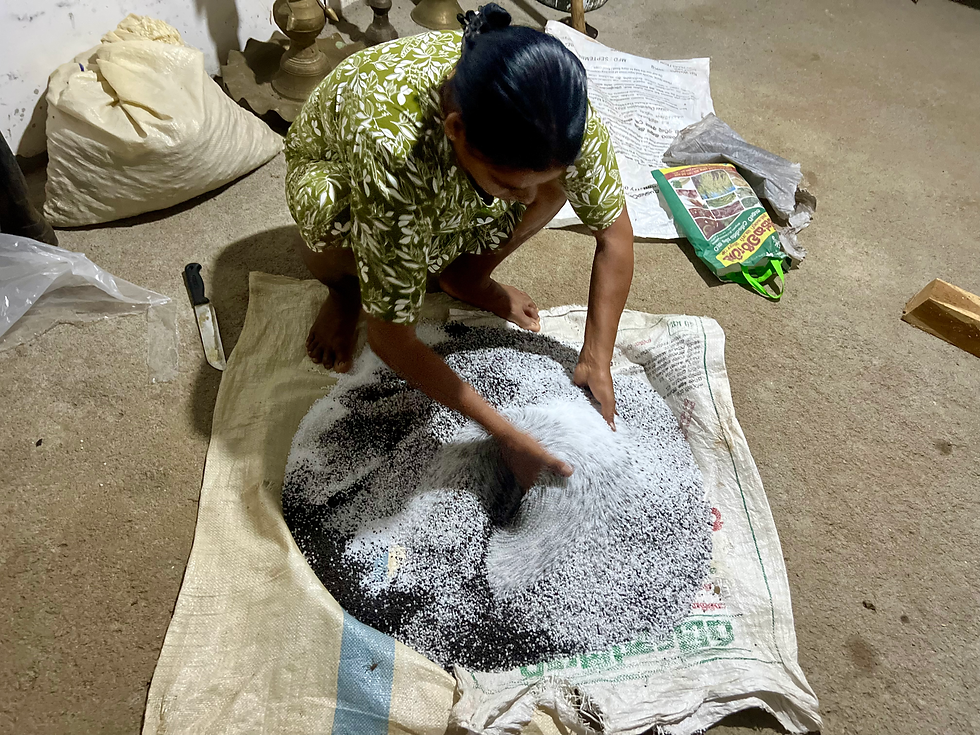
We reached the plot she tends with such intimate familiarity. She lowered the bag to the earth, invited me to steady it, and urged me to tilt it just so, letting the moisture-dimmed particles spill onto a cloth bag she held. Then she carried that bag out into the field and began to scatter the tiny beads of fertiliser by hand, methodically, as if each grain had a story to tell. She moved with precision, ensuring every corner of the patch received its share. The sun climbed higher, transforming the air into a warm, almost tangible presence that pressed on us and pressed on the land. She pressed onward, and I hovered on the periphery, drawn by both admiration and fatigue for the effort in her wake. After an hour of careful application, she had tended all her plots, and I found myself unexpectedly spent, though I had done little more than watch.
We drifted back to the scooter and began the ride home, the fields shrinking behind us as the road unfurled ahead. The hike in the heat lingered in my thoughts, a stark reminder of how farmers in rural Sri Lanka shoulder heavy, often hazardous tasks with bare hands and bare faces, untethered by masks or safety gear. When I asked my host about it, she spoke with quiet pragmatism: this is how it’s always been, a reality not fully framed by safety norms, but rather by habit and necessity.
From this day, shadowed by the sun and framed by resilience, I carried a new image of strength, a strength not loud or fast, but steady, patient, and unyielding. Paddy farming is a labor of time and touch, a rhythm that belongs to families who trade off the duties across generations. My host, in particular, did the lion’s share, preparing the land, weeding, sowing, and caring for the plants through their long arc of growth, carving out a role that felt less like a duty and more like an art she had learned to perform with her own two hands.



Comments